SndMachine
A few months ago I built, what was my second electronics project, a generative tone device that operated as a MIDI instrument.
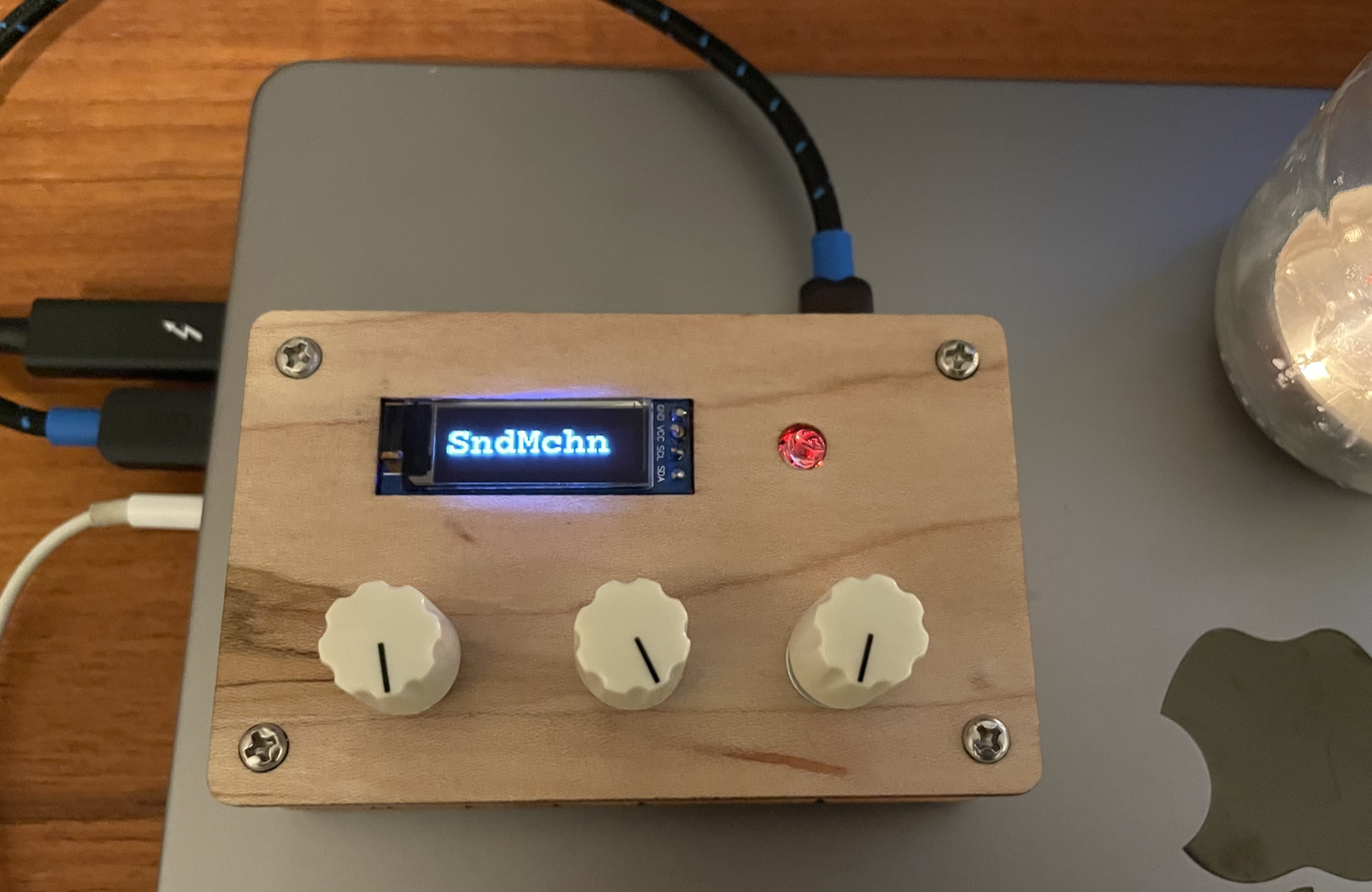
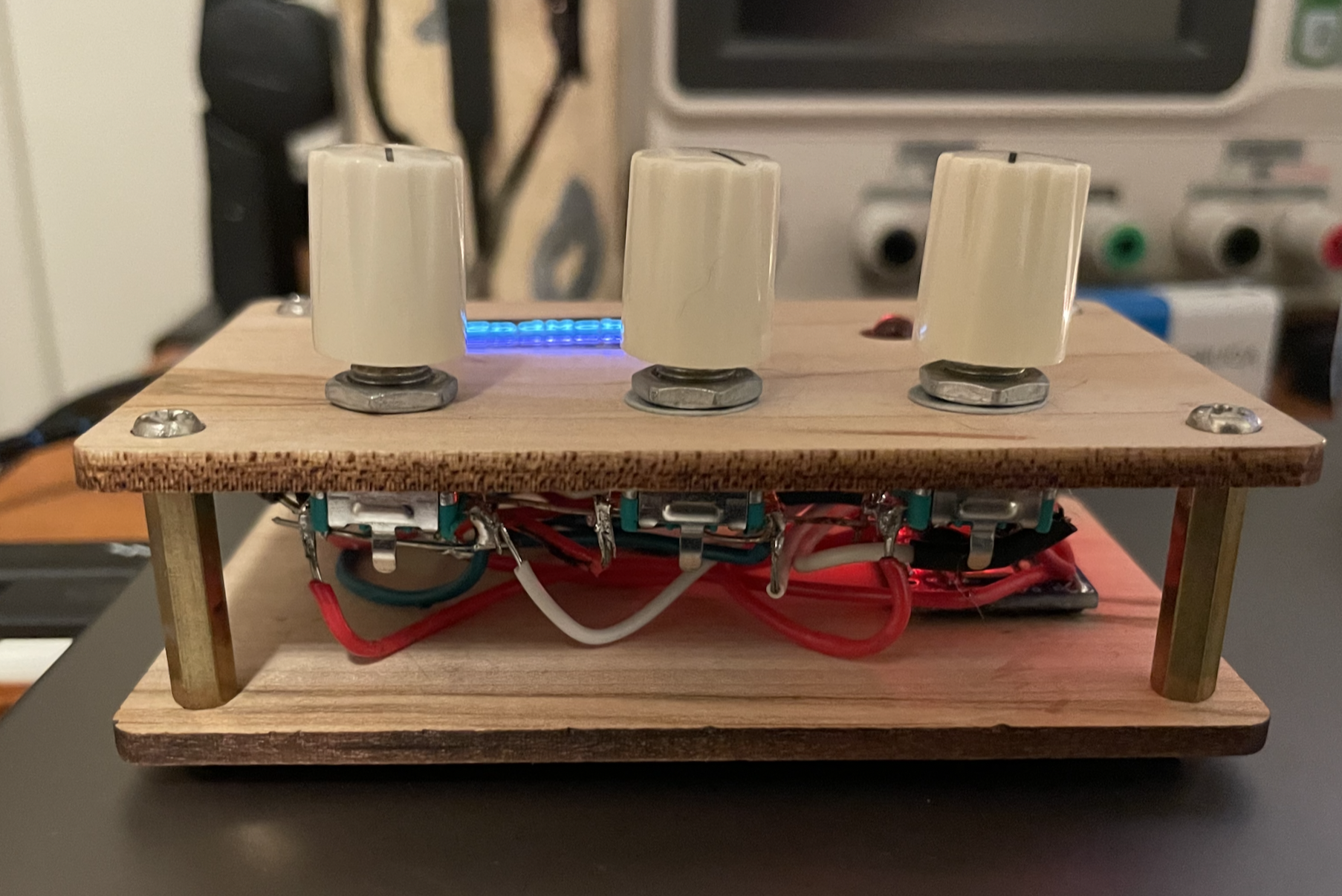
I used an arduino pro micro, three encoders, a small display, and built a little wooden enclosure. There is no PCB and all the wiring is free-form, point-to-point.
The sides of the enclosure are open so you can see into the device.
The Algorithm
The kernel of my idea was to create a generative algorithm based on cellular automata theory. Years ago I read bits and pieces of Stephen Wolfram’s “A new kind of science” and some of the ideas stuck with me). More recently I learned that Brian Eno explored CA in some of his music.
From an interview in Wired Magazine (1996):
Q: Has Mr. Eno explored cellular automata in the creation of his dynamic music?
Eno: That’s a very pertinent question. In fact the origin of my understanding that it could be done by computer was from watching the game Life, John Conway’s cellular automata game, at the Exploratorium. In 1978, I became completely addicted to this game. I would sit there five or eight hours at a time, watching Life play itself out. Many of you know this; Life is a very simple set of rules; three rules that govern the growth and decline of the population of dots on a screen. It’s exquisitely elegant. If you tried to do it without a computer, it would take several years. The interaction of simple rules can lead to very complex results. I was thrilled at getting complexity out of simplicity. Since then, I’ve looked at other cellular automata.
And I also discovered via web search various amateur musicians playing with these ideas as well.
After not much introspection, I ended up creating a 16-note buffer, like in a 16-note sequencer and some basic rules of mutation. My thinking was that the rules could be tweaked by the algorithm knob which could do things like (a) change the rule, (b) drop notes randomly, (c) shift scales, etc.
First run
I connected the device up to my iPhone and fired up garage band. It made played sounds. Yay.
I (temporarily) moved onto other projects.
Discovering modular synths
For the last few months I’ve been building a guitar effects pedal circuit (detailed in other posts) and have been thinking about analog audio. Last week I “discovered” modular synths. I had been vaguely aware of modular synths having seen videos of Kraftwerk and New Order in front of a sea of audio equipment, flashing lights, and patch cables. But I never really understood that they were synthesizers decomposed into fundamental parts: oscillators, amplifiers, filters, sequencers all with clock inputs/outputs, voltage control inputs/outputs and patched together with cables to make otherworldly sounds and complex beats. I had already split my guitar effects pedal into three parts and plugged them together with patch cables, not realizing it was a kind of “modular synth-y deconstruction”.
Using SndMchn with VCV Rack
VCV rack is an open source virtual synth platform -- software that runs on your laptop and lets you explore virtual versions of thousands of synth modules.
VCV rack has a MIDI to CV module and so yesterday I hooked up some modules and connected SndMchn up to it.
Next Steps
After discovering the modular synth world on youtube, I’m re-energized to work on SndMchn and generative music again.
Some things on my list:
-
Add the ability to for SndMchn to receive an arbitrary clock signal over MIDI from VCV Rack.
-
Go deeper into the algorithms and add the ability to tweak them during sequencing.
-
Rebuild SndMchn as a modular synth module, having it provide CV out for tones and take clock input for timing.
- ← Previous
First end-to-end test - Next →
Planting cucumbers